The semester is coming to an end. I have a list of events on my office door as a reminder to my students, and each time one is accomplished I have to make a real effort not to take a big black marker and cross it off the list. I did enjoy looking at it this morning and realizing that more than half of the events were in the past.
Tonight was the final concert for the chamber groups I've been coaching. That means my schedule gets notably lighter from now till the end of the term (a glorious week and a half from now), as I won't have any more coachings with those groups. The concert went well, I think. I spent the evening backstage herding my students.
"Where's the quartet? You're next! Have you tuned?"
"I count eleven. Who's missing? TER!!!"
One student even asked me to tie his tie for him. Not a skill I've acquired, I have to say. Husband thinks I should learn. I'm not sure why.
Wednesday, February 15, 2006


legal once again
We're back from Singapore. We've got new visas. All is well in immigration land.
Father-in-Law sent us a really scary online news item about people who have visa problems in the U.S. Evidently we had it easy.
While on the trip I was able to get a little work coaching Singaporean secondary school students who play in their school bands. It's not my favorite kind of work, but I think it was OK. I am never sure what, exactly, is expected of me at these events. At one of them I had 31 students of widely varying skill levels, and 2 vast hours of time in which to impart my wisdom. The way I see it, I've got three options:
I actually tried to vary things as much as I could, and to couch things in language that could help everyone. It's not for nothing that I learned what a "spiral curriculum" is. I don't have any idea how well I succeeded. I guess I'll find out when I get asked back...or not.
The only thing that I'm sure went well was the performing I did. I played some very modern music (3 pieces, all composed in the 1990s) by pomo (are we in po-pomo yet? 'cause that's what I'd really like to call them) composers who are trying to combine two musical traditions. This is quite a hobbyhorse for me and I think I explain it well. The only question is, does it matter? Do the students hear anything besides "danger, Will Robinson! Weird music!"
Anyway, Singapore was great as always, although our attempts at tourism were notably less successful than last time. A few highlights:
Our map of Singapore showed a public aquarium. We arrived at where it should be and found nothing. Eventually we learned it was torn down over 10 years ago. We wound up getting drenched, as the rain (which, in its imminence, was the reason we decided on an indoor activity in the first place) really got going.
I remember going to a botanical garden or orchid garden that was really interesting and beautiful. We went to what we thought was the place, and...not so much. I have to think we were at some other orchid garden that's trying to capitalize on dumb tourists like us who think they're the big public one. This was essentially a big nursery that charges $3.00 for the privilege of coming in and shopping for plants. Fabulous.
Father-in-Law sent us a really scary online news item about people who have visa problems in the U.S. Evidently we had it easy.
While on the trip I was able to get a little work coaching Singaporean secondary school students who play in their school bands. It's not my favorite kind of work, but I think it was OK. I am never sure what, exactly, is expected of me at these events. At one of them I had 31 students of widely varying skill levels, and 2 vast hours of time in which to impart my wisdom. The way I see it, I've got three options:
- Start from the beginning (the correct way to put your instrument together without breaking it). This would engage the beginners and bore the high achievers.
- Focus on the advanced students, teaching them good finger technique, embouchure skills, and efficient practicing models. This does the opposite, leaving the beginners in the dust.
- Teach to the imaginary middle: too advanced for the beginners, too easy for the advanced students. This alienates everyone.
I actually tried to vary things as much as I could, and to couch things in language that could help everyone. It's not for nothing that I learned what a "spiral curriculum" is. I don't have any idea how well I succeeded. I guess I'll find out when I get asked back...or not.
The only thing that I'm sure went well was the performing I did. I played some very modern music (3 pieces, all composed in the 1990s) by pomo (are we in po-pomo yet? 'cause that's what I'd really like to call them) composers who are trying to combine two musical traditions. This is quite a hobbyhorse for me and I think I explain it well. The only question is, does it matter? Do the students hear anything besides "danger, Will Robinson! Weird music!"
Anyway, Singapore was great as always, although our attempts at tourism were notably less successful than last time. A few highlights:
Our map of Singapore showed a public aquarium. We arrived at where it should be and found nothing. Eventually we learned it was torn down over 10 years ago. We wound up getting drenched, as the rain (which, in its imminence, was the reason we decided on an indoor activity in the first place) really got going.
I remember going to a botanical garden or orchid garden that was really interesting and beautiful. We went to what we thought was the place, and...not so much. I have to think we were at some other orchid garden that's trying to capitalize on dumb tourists like us who think they're the big public one. This was essentially a big nursery that charges $3.00 for the privilege of coming in and shopping for plants. Fabulous.
Tuesday, February 14, 2006
Sunday, February 05, 2006
nicknames
All Thai people have three names: the first name ("cheu"), the last name ("nam sagoon"), and the nickname (don't know the Thai for this one). The last name is rarely used and is only really necessary for official documents. This is true among professionals and people of all walks of life. That means my students refer to me as Ajarn Hermione (for instance), not Ajarn Granger.
The nickname is the really interesting one. In America a nickname is generally a diminutive form of a first name--Mike for Michael or Beth for Elizabeth. Other, more descriptive nicknames (think "Shorty" or "Big Larry") are generally reserved only for the most casual situations.
Not so in Thailand. First of all, everyone has a nickname. While some of them are derived from one's "cheu," most are not. People are given their nicknames by their parents, in infancy or childhood, and the nicknames stay with them throughout their lives. Some of them have obvious descriptive Thai meanings, some of them refer to animals (and never in a derogatory way--a person can be a "pig" here with no negative connotations at all), some are actually English words, and some are English or American names chosen for their sound.
Your nickname, whether descriptive or not, is used by anyone who knows you more than slightly. Your family, your friends, and your business acquaintances may call you by your nickname. When I first arrived everyone wanted to know my nickname and all were very surprised when I told them I didn't have one. I suspect they were a little disappointed also, as my name is both difficult for Thai people to pronounce and not really amenable to shortening.
Here are some of the nicknames of people (students, teachers, and staff) at the university. (I do love a bulleted list.)
The nickname is the really interesting one. In America a nickname is generally a diminutive form of a first name--Mike for Michael or Beth for Elizabeth. Other, more descriptive nicknames (think "Shorty" or "Big Larry") are generally reserved only for the most casual situations.
Not so in Thailand. First of all, everyone has a nickname. While some of them are derived from one's "cheu," most are not. People are given their nicknames by their parents, in infancy or childhood, and the nicknames stay with them throughout their lives. Some of them have obvious descriptive Thai meanings, some of them refer to animals (and never in a derogatory way--a person can be a "pig" here with no negative connotations at all), some are actually English words, and some are English or American names chosen for their sound.
Your nickname, whether descriptive or not, is used by anyone who knows you more than slightly. Your family, your friends, and your business acquaintances may call you by your nickname. When I first arrived everyone wanted to know my nickname and all were very surprised when I told them I didn't have one. I suspect they were a little disappointed also, as my name is both difficult for Thai people to pronounce and not really amenable to shortening.
Here are some of the nicknames of people (students, teachers, and staff) at the university. (I do love a bulleted list.)
- Lek (Thai for "small")
- Neung (Thai for "one"--a common nickname for a firstborn)
- Khai (Thai for "egg"--he tells me it refers to the shape of his head)
- Nok (Thai for "bird")
- Moo (Thai for "pig)
- Bpoo (Thai for "crab")
- Bank (the English word "bank"--bestowed by one's parents in the hope of prosperity)
- Josh (the English name)
- Nancy (the English name)
- Woody (an Anglicized version of a shortening of the given name)
- Bowling (yeah, like the game)
mk
The best part about going shopping at Lotus is talking Husband into eating at MK.
MK is a chain restaurant that Thai people say is Chinese. The food tastes pretty Thai to me, but OK. I guess they have dim sum and roast duck in addition to the usual Thai stuff.
Mom tells me that there are restaurants like this in America, but I've never been to one. It's sort of like fondue, in that the food you order comes to the table raw, but instead of frying it one piece at a time you throw everything into a put of broth, and eat it all together like soup. You can get all sorts of vegetables, which is one of the reasons I like it so much, but as usual most of the menu is devoted to meat. Pages and pages of meat. Pieces of beef, pork, fish, shrimp, crab, and various processed meats. Livers. Kidneys. Hearts. Stomachs. All with pictures, which is another reason why I like to eat there--unlike at most other places, where I have to rely on the small number of dishes that I already know how to ask for and can reasonably expect any cook to know how to make, at MK I can point at a picture of what I want and know exactly what I'm getting.
Illiteracy. The Thai written language remains as incomprehensible to me as it was when I first arrived. I can't read official documents, university memos, menus, street signs, or warning labels. I can't even write my own name. I have been reading in English for almost my entire life; I can't remember being unable to read. I'm experiencing it now, and it's humbling, frustrating, and humiliating. The obvious answer, of course, is to learn. That has been my approach to everything else in my life. Knowledge is power, right? It's always worked for me so far (I was in school for how many years?), but I think I've run up against a firm barrier this time. It may not be true that I cannot learn to read Thai, but it is certainly true that I cannot learn it while continuing to devote most of my time to my job. I am illiterate and will remain that way for the foreseeable future.
MK is a chain restaurant that Thai people say is Chinese. The food tastes pretty Thai to me, but OK. I guess they have dim sum and roast duck in addition to the usual Thai stuff.
Mom tells me that there are restaurants like this in America, but I've never been to one. It's sort of like fondue, in that the food you order comes to the table raw, but instead of frying it one piece at a time you throw everything into a put of broth, and eat it all together like soup. You can get all sorts of vegetables, which is one of the reasons I like it so much, but as usual most of the menu is devoted to meat. Pages and pages of meat. Pieces of beef, pork, fish, shrimp, crab, and various processed meats. Livers. Kidneys. Hearts. Stomachs. All with pictures, which is another reason why I like to eat there--unlike at most other places, where I have to rely on the small number of dishes that I already know how to ask for and can reasonably expect any cook to know how to make, at MK I can point at a picture of what I want and know exactly what I'm getting.
Illiteracy. The Thai written language remains as incomprehensible to me as it was when I first arrived. I can't read official documents, university memos, menus, street signs, or warning labels. I can't even write my own name. I have been reading in English for almost my entire life; I can't remember being unable to read. I'm experiencing it now, and it's humbling, frustrating, and humiliating. The obvious answer, of course, is to learn. That has been my approach to everything else in my life. Knowledge is power, right? It's always worked for me so far (I was in school for how many years?), but I think I've run up against a firm barrier this time. It may not be true that I cannot learn to read Thai, but it is certainly true that I cannot learn it while continuing to devote most of my time to my job. I am illiterate and will remain that way for the foreseeable future.
padme
The Buddhist mantra "Om mani padme hung" has to do with the lotus (you can breathe that sigh of relief you've been saving up--I don't remember exactly what the mantra means and I'm not going to try to make something up). Yogis sit in padmasana, or lotus pose, for meditation. We also revere the lotus, in our way.
Tesco Lotus, that is.
Tesco Lotus is one of two chains of big-box department stores (the other is Big C) around Bangkok. It's as close as Thailand gets to Target. We have bought everything from particle board furniture to bedsheets to banana muffins at Lotus. Every couple of weeks we take a taxi to the nearest Lotus and stock up on toiletries, snacks, and whatever else we need.
Today we got into the taxi and told the driver "Lotac Bangyai" as usual ("Lotac" is the Thai pronunciation for "Lotus," and Bangyai is the town in which said Lotus is blossoming). However, instead of continuing down the main street of the town to the expressway, which is the normal route we take, this driver turned down a side street.
Husband and I raised our eyebrows--where were we going? We decided to wait and see--we were going in the correct compass direction, after all.
As it turned out, the driver knew a shortcut. A real one, that was both shorter and faster than the expressway. It was a meandering, narrow road with one lane in each direction...theoretically. The driver, however, preferred to drive on the right, or incorrect, side of the road. Rules, schmules! When he saw a motorcycle coming towards him (you know, going the direction that one should be going on that side of the road), our taxi driver did not pull over. He did not slow down. He did not get over into the correct lane. No, our driver actually honked his horn at the other, law-abiding driver! Now that's chutzpah.
Anyway, this shortcut was actually very enjoyable. We saw a part of the area that we'd never seen before. Farms, isolated houses, people in wide-brimmed straw hats and loose blue clothes actually working in the fields (think back to the travel books on Thailand you've seen--there is a picture like this in all of them, but as a tourist you're never going to see anything of the kind). Best of all, several extremely ornate temples. We were only driving past, of course, but they were still spectacular.
Tesco Lotus, that is.
Tesco Lotus is one of two chains of big-box department stores (the other is Big C) around Bangkok. It's as close as Thailand gets to Target. We have bought everything from particle board furniture to bedsheets to banana muffins at Lotus. Every couple of weeks we take a taxi to the nearest Lotus and stock up on toiletries, snacks, and whatever else we need.
Today we got into the taxi and told the driver "Lotac Bangyai" as usual ("Lotac" is the Thai pronunciation for "Lotus," and Bangyai is the town in which said Lotus is blossoming). However, instead of continuing down the main street of the town to the expressway, which is the normal route we take, this driver turned down a side street.
Husband and I raised our eyebrows--where were we going? We decided to wait and see--we were going in the correct compass direction, after all.
As it turned out, the driver knew a shortcut. A real one, that was both shorter and faster than the expressway. It was a meandering, narrow road with one lane in each direction...theoretically. The driver, however, preferred to drive on the right, or incorrect, side of the road. Rules, schmules! When he saw a motorcycle coming towards him (you know, going the direction that one should be going on that side of the road), our taxi driver did not pull over. He did not slow down. He did not get over into the correct lane. No, our driver actually honked his horn at the other, law-abiding driver! Now that's chutzpah.
Anyway, this shortcut was actually very enjoyable. We saw a part of the area that we'd never seen before. Farms, isolated houses, people in wide-brimmed straw hats and loose blue clothes actually working in the fields (think back to the travel books on Thailand you've seen--there is a picture like this in all of them, but as a tourist you're never going to see anything of the kind). Best of all, several extremely ornate temples. We were only driving past, of course, but they were still spectacular.
bike in a tree
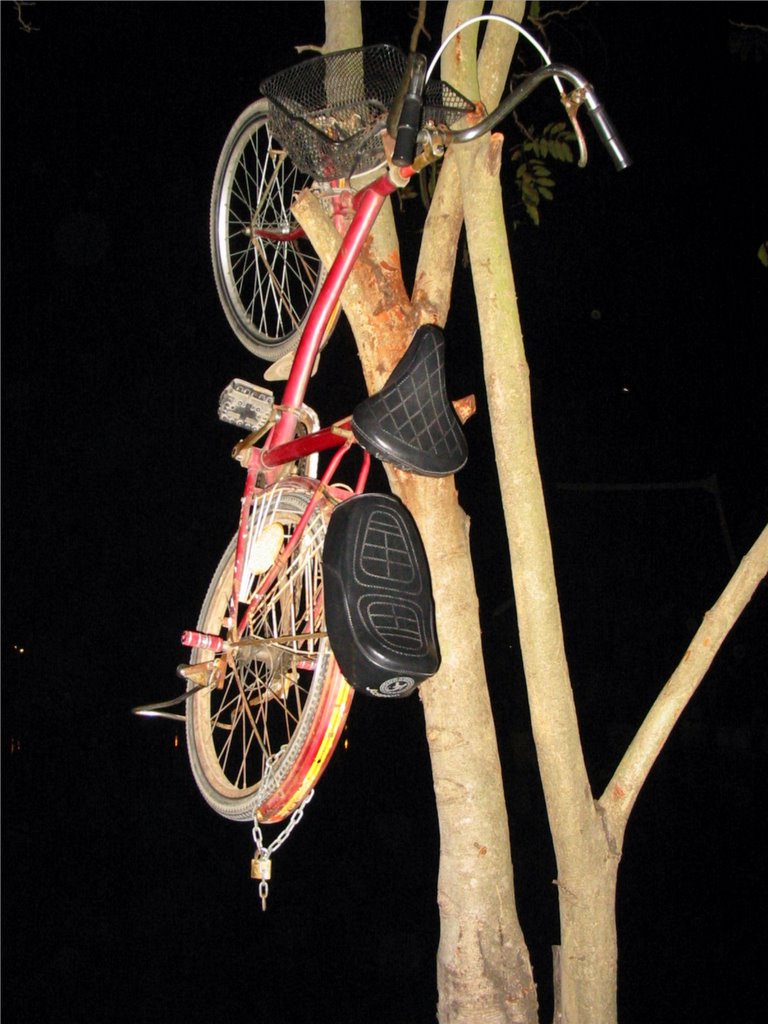 It's a bike.
In a tree.
This is a common sight around the university. I'm convinced it's a prank played on people by their buddies; Husband thinks people put their own bikes in trees to keep them from being stolen.
Wednesday, February 01, 2006
thainglish
My students' English is better than my Thai. So much better, in fact, that I am constantly humbled by their ability to converse with me. Some students who couldn't even say "hello" six months ago are now able to have conversations with me. They are even starting to learn Italian and French musical terms. (German, for some reason, is proving to be more difficult.)
While my Thai skills are languishing, I am becoming more adept at understanding what my students really mean when they say certain things in English.
For instance:
"Not sure" means "Absolutely not, but I will never answer my teacher in the negative."
"OK" often means "I have no idea what you just said, but you are clearly waiting for some kind of response." (Sometimes it actually means "OK.")
They are also becoming more adept at predicting my (perhaps too formulaic?) responses to their playing. They will often try to beat me to the punch, saying what they think I'm about to say.
For instance:
"Again please." I never have to say this anymore. They say it for me. I think it's become some kind of an inside joke among them.
Often when they come in for their lessons, after the hellos and how-are-yous, I ask "Are you ready?" Now, sometimes a student will come in and the first thing out of his mouth is "I am ready."
They know that lessons always start with scales. Call me rigid, call me doctrinaire, and Betty when you call me you can call me Al....oh wait, sorry. Where was I? Lessons always start with scales. Several of my students will come in, put their music on the stand, and announce, "Scale." What's interesting about this is that the Thai pronunciation of the word "scale" has three syllables. "Sah-cay-un."
Then there is the other side of the coin: I do know enough Thai that sometimes it's easier for me to get my point across by using Thai words. I often find myself saying things like these sparkling linguistic jewels:
"Crescendo nit-noy."
While my Thai skills are languishing, I am becoming more adept at understanding what my students really mean when they say certain things in English.
For instance:
"Not sure" means "Absolutely not, but I will never answer my teacher in the negative."
"OK" often means "I have no idea what you just said, but you are clearly waiting for some kind of response." (Sometimes it actually means "OK.")
They are also becoming more adept at predicting my (perhaps too formulaic?) responses to their playing. They will often try to beat me to the punch, saying what they think I'm about to say.
For instance:
"Again please." I never have to say this anymore. They say it for me. I think it's become some kind of an inside joke among them.
Often when they come in for their lessons, after the hellos and how-are-yous, I ask "Are you ready?" Now, sometimes a student will come in and the first thing out of his mouth is "I am ready."
They know that lessons always start with scales. Call me rigid, call me doctrinaire, and Betty when you call me you can call me Al....oh wait, sorry. Where was I? Lessons always start with scales. Several of my students will come in, put their music on the stand, and announce, "Scale." What's interesting about this is that the Thai pronunciation of the word "scale" has three syllables. "Sah-cay-un."
Then there is the other side of the coin: I do know enough Thai that sometimes it's easier for me to get my point across by using Thai words. I often find myself saying things like these sparkling linguistic jewels:
"Crescendo nit-noy."
- crescendo: Italian musical term for "get louder"
- nit-noy: Thai for "a little bit"
- mai chai: Thai for "is not"
- A major and F# minor: two tonalities that have the same key signature
- mee: Thai for "have"
- E#: the note that is a dead giveaway for F# minor
- ni: Thai for "this"
- ein wenig bewegter: German musical term for "a little more agitated"
- same-same: Thainglish for, well, same-same
- un poco agitato: Italian musical term, same-same ein wenig bewegter
another new year party

Yes, the New Year celebrations are still in full swing. This is a party on campus, presumably for students. Note the vertical hanging fluorescent lights.
Subscribe to:
Posts (Atom)